
Abstract
Tianeptine is an antidepressant medication approved in several countries outside the United States but is not approved by the U.S. Food and Drug Administration (FDA). Despite this, tianeptine is sold in non-pharmacy retail settings under brand names such as ZaZa Red, Pegasus, Neptune’s Fix, TD Red, and others. It has been associated with misuse, opioid-like dependence, and withdrawal. Pharmacist awareness of this emerging substance remains poorly characterized. To assess baseline awareness and depth of knowledge regarding tianeptine misuse, withdrawal, and management among licensed pharmacists. Two separate anonymous, cross-sectional surveys were administered online.The first survey was to determine if the Respondents were aware of Tianeptine. The first survey showed that the respondent was unaware of tianeptine. Respondents who reported familiarity were asked to complete a more detailed knowledge survey. Descriptive statistics were used to summarize responses. In the first survey, 100% of participants (n = 38) reported no prior awareness of tianeptine or related branded products. In the second survey (n = 22), most respondents practiced in community pharmacy (59.1%) and had 10 or more years of experience (81.8%). Knowledge of abuse potential, withdrawal symptoms, and treatment options was limited. And 71.4% of respondents did not feel comfortable offering counseling to patients about the risks of tianeptine usage. Licensed Pharmacists' awareness and confidence regarding tianeptine misuse and management are low. The survey results and key findings highlight a critical educational gap with implications for patient safety and public health.
Keywords: Pharmacist Awareness, Tianeptine, Gas Station Heroin
Introduction
Tianeptine is an atypical tricyclic antidepressant approved for the treatment of major depressive disorder in several countries outside the United States, such as those located in Europe and Asia. Still, it is not approved by the U.S. Food and Drug Administration (FDA).[1] In recent years, tianeptine has become widely available in the United States through gas stations, convenience stores, smoke/vape retailers, and online vendors, where it is marketed as a dietary supplement or cognitive enhancer under brand names such as ZaZa Red, Pegasus, Neptune’s Fix, TD Red, and others.[1][2]
Pharmacologically, tianeptine differs from traditional antidepressants in that it is molecularly similar to tricyclic antidepressants (TCAs). Unlike traditional TCAs, it also acts on the μ-opioid receptor, which likely plays a role in its effects and potential for misuse and abuse.[3] Experimental and clinical evidence indicates that repeated tianeptine use may lead to tolerance, dependence, and a withdrawal syndrome resembling opioid withdrawal, characterized by gastrointestinal distress, autonomic symptoms, anxiety, agitation, and dysphoria.[4][5]
Public health concerns surrounding tianeptine have increased significantly. Poison center surveillance data demonstrate a marked rise in tianeptine-related exposures in the United States, with reports of severe toxicity and hospitalization.[5] In 2024, the Centers for Disease Control and Prevention (CDC) reported an outbreak of severe illness in New Jersey associated with Neptune’s Fix, noting that some products contained additional psychoactive substances, further complicating clinical management.[2] The FDA has since issued national safety warnings emphasizing the risk of overdose, dependence, and death associated with tianeptine products.[1]
Emerging, unregulated substances like tianeptine can take a real toll on both families and communities, contributing to more emergency department visits and added social and financial strain. Pharmacists are often the most accessible healthcare professionals, putting them in a key position to recognize early signs of misuse, educate patients, and connect them with appropriate treatment and support. However, there is still limited information on how aware pharmacists are of tianeptine, whether they recognize its branded products, and how confident they feel managing misuse or withdrawal. This study sought to address this significant gap.
Methods
Study Design
This study employed a two-cross-sectional survey design, using anonymous Google Forms that were administered between December 2025 and February 2026.
Survey Instruments
The initial screening survey consisted of a single yes/no question assessing whether participants had heard of tianeptine or encountered patients using or withdrawing from it.
Participants who indicated familiarity were invited to complete a second, detailed knowledge survey, which assessed:
- Demographic and practice characteristics
- Recognition of tianeptine brand names
- Perceived abuse potential
- Signs and symptoms of misuse and withdrawal
- Perceived prevalence trends
- Treatment knowledge
- Confidence in patient counseling
Participants
Participants were licensed pharmacists practicing in the United States. Participation was voluntary and anonymous. The student obtained Institutional Review Board approval for both surveys from the Appalachian College of Pharmacy.
Data Analysis
The survey results were summarized using descriptive statistics, primarily reporting frequencies and percentages.
Results
Screening Survey: Baseline Awareness
A total of 38 licensed pharmacists completed the first survey, which consisted of a single yes/no question about whether they were aware of tianeptine. All respondents (100%) reported no prior awareness of tianeptine or its branded products at the time of initial screening.
Knowledge Survey: Respondent Characteristics
Twenty-two pharmacists completed the second detailed knowledge survey.
Years in practice:
- 10 years or more (81.8%), 6 – 10 years (4.5%), 1 – 5 years (13.6%)
Primary practice setting:
- Community pharmacy (59.1%), clinical/institutional pharmacy (31.8%), specialty or managed care settings (9.1%).
Awareness and Understanding
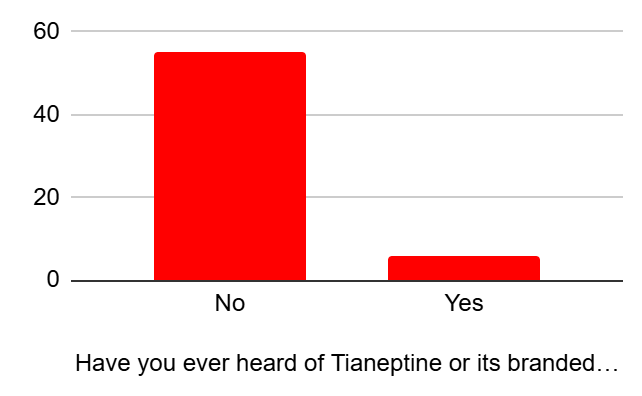
When participants were asked whether they were familiar with tianeptine or any of its branded names, in total, 10% reported at least some familiarity. In comparison, 90% said they were not at all familiar.Those who had heard of it most often learned about it from news articles, conversations with colleagues, clinical literature, or patient encounters.
Regarding medical use, 45% correctly identified tianeptine as an antidepressant used outside the United States, while 55% recognized that it was sold in non-pharmacy retail settings. Only 5% believed it was FDA-approved, which was incorrect.
Perceived Abuse Potential and Access
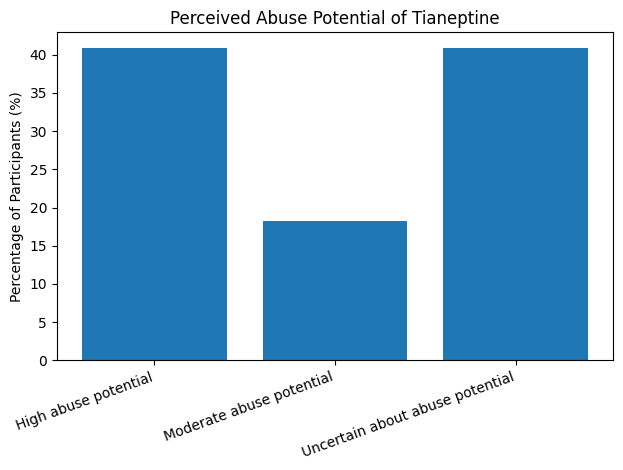
Perceived abuse potential varied, with 40.9% identifying high potential for abuse, 18.2% identifying moderate potential, and 40.9% reporting uncertainty. Most respondents (63.2%) identified gas stations as the most common point of purchase.
Signs, Symptoms, and Abuse Recognition
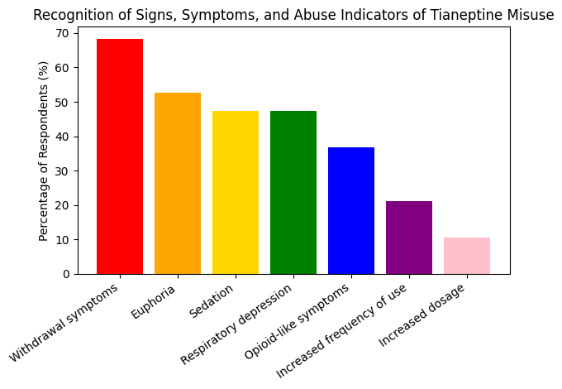
Respondents most commonly identified withdrawal symptoms (68.4%), euphoria (52.6%), sedation (47.4%), and respiratory depression (47.4%) as manifestations of tianeptine misuse. Criteria used to differentiate abuse included opioid-like symptoms (36.8%), increased frequency of use (21.1%), and increased dosage (10.5%).
Trends and Treatment Knowledge
More than half of respondents (54.5%) were unsure whether tianeptine-related presentations were increasing. Most respondents (59.1%) were unaware of any FDA-approved treatments for tianeptine misuse or overdose, and only 9.1% reported awareness of specific treatment options. At this time, there are no FDA-approved treatments or guidelines for tianeptine withdrawal.
Interventions for patients included referral to addiction specialists (63.2%), use of opioid antagonists (52.6%), and symptomatic management (47.4%).
Counseling Confidence
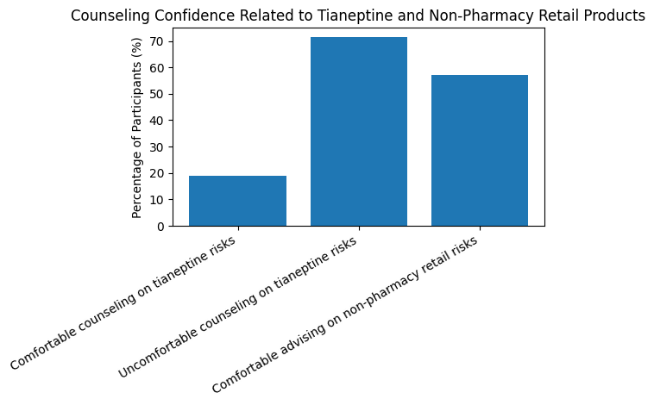
Only 19% of participants reported feeling comfortable counseling patients about the risks of tianeptine, while 71.4% reported discomfort. In contrast, 57.1% felt comfortable advising patients about the risks of purchasing substances from non-pharmacy retail locations.
Discussion
These two surveys demonstrate a substantial lack of baseline awareness and limited applied knowledge of tianeptine among licensed pharmacists. Even among experienced practitioners, confidence in recognizing misuse, managing withdrawal, and counseling patients was low. These findings are concerning, given increasing reports of tianeptine-related harm and the accessibility of these products in retail settings. [1] [2] [5]
Importantly, no randomized controlled trials (RCTs) have evaluated tianeptine misuse, dependence, or withdrawal management in humans. Available evidence is limited to poison center surveillance, case reports, observational studies, and animal models demonstrating opioid-like reinforcing effects and withdrawal behaviors. [3] [6] The lack of strong clinical evidence may leave clinicians feeling unsure and highlights the need for better education as well as more research.
Limitations
The smaller sample size, reliance on self-reported data, and potential selection bias limit this study. Results may not be representative of all pharmacists. However, the results highlight an important knowledge gap that warrants further investigation.
Conclusions
Pharmacist awareness and confidence regarding tianeptine misuse and management are low. Targeted education, enhanced surveillance, and additional studies are necessary to understand better and limit the public health impact of this unregulated substance.
Acknowledgments
The author gratefully acknowledges the valuable contributions of Dr. Randy Mullins, Associate Professor and Chair of the Department at the Appalachian College of Pharmacy, for their expert review and comprehensive editorial support.
Conflict of interest
The authors declare no Conflict of interest.
References
- U.S. Food and Drug Administration. FDA warns consumers about the dangers of tianeptine (“gas station heroin”). Published May 8, 2025. Accessed February 2026.
https://www.fda.gov/drugs/drug-safety-and-availability/fda-warns-consumers-not-purchase-or-use-any-tianeptine-product-due-serious-risks - Counts CJ, Spadaro AV, Cerbini TA, et al. Notes from the Field: Cluster of Severe Illness from Neptune’s Fix Tianeptine Linked to Synthetic Cannabinoids — New Jersey, June–November 2023. MMWR Morb Mortal Wkly Rep 2024;73:89–90. DOI: http://dx.doi.org/10.15585/mmwr.mm7304a5
- Gassaway MM, Rives ML, Kruegel AC, Javitch JA, Sames D. The atypical antidepressant and neurorestorative agent tianeptine is a μ-opioid receptor agonist. Transl Psychiatry. 2014;4(7):e411. Published 2014 Jul 15. doi:10.1038/tp.2014.30 https://pubmed.ncbi.nlm.nih.gov/28303899/
- Edinoff AN, Sall S, Beckman SP, et al. Tianeptine, an Antidepressant with Opioid Agonist Effects: Pharmacology and Abuse Potential, a Narrative Review. Pain Ther. 2023;12(5):1121-1134. doi:10.1007/s40122-023-00539-5 https://pmc.ncbi.nlm.nih.gov/articles/PMC10444703/
- Quadir M, Rine NI, Badeti J, et al. Tianeptine Exposures Reported to United States Poison Centers, 2015-2023. J Med Toxicol. 2025;21(1):30-41. doi:10.1007/s13181-024-01053-6 https://pubmed.ncbi.nlm.nih.gov/39724478/
- Samuels BA, Nautiyal KM, Kruegel AC, et al. The Behavioral Effects of the Antidepressant Tianeptine Require the Mu-Opioid Receptor. Neuropsychopharmacology. 2017;42(10):2052-2063. doi:10.1038/npp.2017.60 https://pubmed.ncbi.nlm.nih.gov/28303899/
Note
Copyright © 2026 Keen. Place of Publication: PSciP Publishing LLC, VA, USA.